Retinol vs. Retinyl Palmitate: What Actually Builds Collagen Without Aging Your Skin Faster
For years, retinol has been positioned as the gold standard in anti-aging skincare. If you want collagen, smoother texture, and fewer fine lines, the message seems simple: go stronger.
But there’s a question most skincare advice never asks:
If retinol builds collagen, why do so many long-term users end up with thinner, more reactive, irritated skin over time?
The answer isn’t that retinol doesn’t work — it does.
The answer is that collagen stimulation alone is not the same thing as skin longevity.
The Retinol Paradox
Vitamin A derivatives (retinoids) are among the most researched ingredients in dermatology. They:
- Increase cell turnover
- Support collagen production
- Improve texture and tone
Yet many users experience:
- Chronic dryness and redness
- Heightened sensitivity
- Barrier damage
- A cycle of stopping, “repairing,” and restarting actives
This isn’t misuse. It’s biology.
Skin that is constantly correcting irritation has less capacity to regenerate long-term structure.
Vitamin A Forms Explained (Without the Potency Trap)
All topical vitamin A works by delivering the same biological message:
increase renewal and support collagen production.
The difference between retinyl palmitate, retinol, retinaldehyde, and tretinoin is not whether they work, but how much physiological stress the skin absorbs in order to respond.
Fewer conversion steps create faster visible change — but also increase irritation, inflammation, and barrier strain. Over time, that strain can undermine the very collagen these ingredients are meant to support.
Retinoid Comparison for Collagen Support
| Retinoid | Conversion Steps to Retinoic Acid | Effectiveness (Collagen Signaling) | Irritation / Inflammation Risk | Best Use Case |
| Retinyl Palmitate | 3 steps | Effective (gradual, cumulative) | Very low | Long-term maintenance, sensitive skin |
| Retinol | 2 steps | Effective | Moderate | Visible anti-aging with tolerance management |
| Retinaldehyde | 1 step | Effective | Moderate–high | Faster results for experienced users |
| Tretinoin | None (already active) | Effective | High | Significant photoaging under medical guidance |
All vitamin A forms are effective at collagen signaling; the difference lies in the inflammatory cost required to deliver that signal.
Why Faster Results Can Age Skin Faster
Retinoids accelerate cell turnover. That’s how they smooth skin and improve fine lines.
But accelerated turnover requires support:
- A resilient skin barrier
- Adequate hydration
- Sufficient lipids
- Controlled (not constant) exfoliation
- Time for recovery
When these supports are missing, skin compensates with inflammation. Chronic micro-inflammation increases collagen-degrading enzymes (MMPs), disrupts barrier function, and accelerates visible aging — even while short-term results may look promising.
Retinyl Palmitate: The Underrated Longevity Retinoid
Retinyl palmitate is often dismissed because it works slowly.
That slowness is precisely why it matters.
Instead of forcing rapid turnover, retinyl palmitate:
- Signals skin gently
- Supports gradual renewal
- Minimizes irritation
- Preserves barrier integrity
- Encourages consistency over decades
Used alone, its effects are modest.
Used within a well-designed system, it becomes strategic.
Why Metrin Uses Retinyl Palmitate — On Purpose
Since 1932, Metrin has never chased trends or overnight transformations. The goal has always been lifelong skin health.
Retinyl palmitate was chosen because it:
- Supports collagen signaling without chronic inflammation
- Works synergistically with controlled exfoliation
- Is suitable for daily, lifelong use
- Respects the skin barrier rather than challenging it
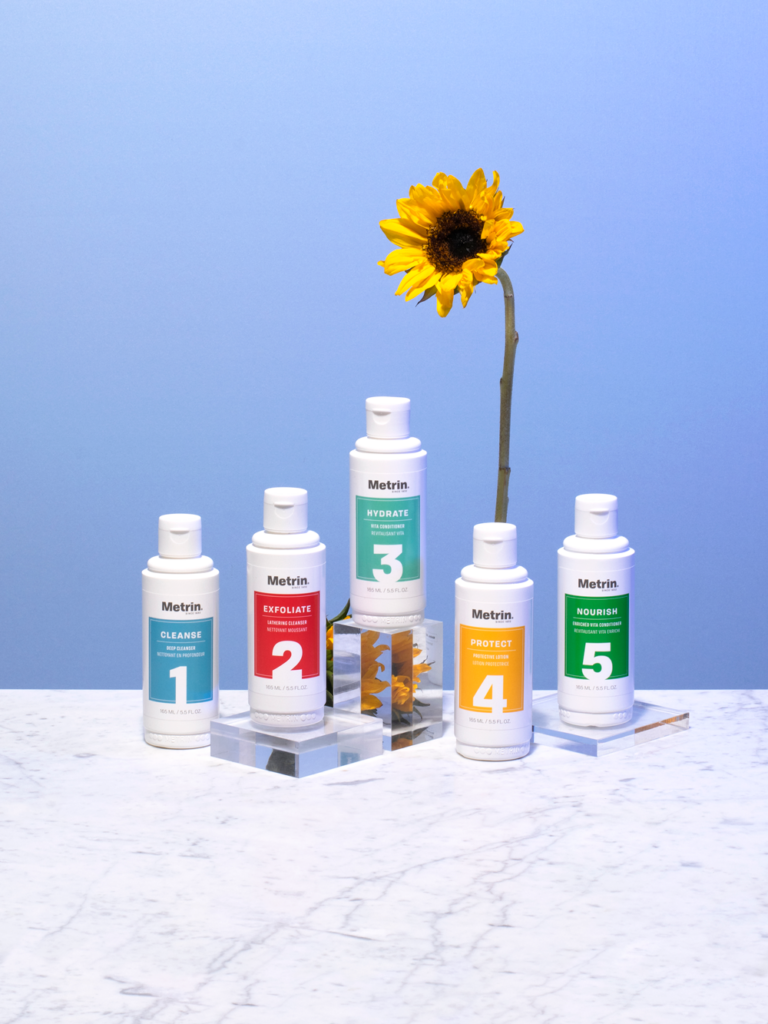
Within the Metrin Skincare System, vitamin A works alongside:
- Thorough yet non-abrasive cleansing
- Periodic exfoliation (not daily peeling)
- Hydration layering
- Lipid replenishment
- Barrier protection
This isn’t an ingredient strategy.
It’s a skin physiology strategy.
Retinol vs. Metrin: A Different Question Entirely
Most skincare comparisons ask:
“Which ingredient works faster?”
Metrin asks:
“What allows skin to function beautifully for decades?”
| Retinol-Focused Routine | Metrin Skincare System |
| Ingredient-driven | System-driven |
| Fast turnover | Balanced renewal |
| Requires cycling & recovery | Designed for consistency |
| Irritation limits longevity | Longevity is the goal |
It’s not about which retinoid works — it’s about which one your skin can sustain for decades.
Who Retinol Often Fails Long-Term
Many people eventually step away from strong retinoids — not because they don’t work, but because they become unsustainable.
This includes:
- Sensitive or reactive skin
- Perimenopausal and menopausal skin
- Barrier-compromised skin
- Anyone tired of “resetting” their routine
For these individuals, skin longevity requires less force and more intelligence.
Ready for Personalised Guidance?
Start with the Metrin Skincare System for Her
Our complete 5-step system is designed for long-term results, not short-lived “glow-ups.”👉 Shop the Metrin Skincare System for Her


Take Our Skin Consultation Questionnaire
Discover your skin’s needs and get tailored guidance.💌 Take the FREE Skin Care Questionnaire and we’ll help you get started.
FAQ
Is retinyl palmitate effective for wrinkles?
Yes. When used consistently within a complete skincare system, retinyl palmitate supports gradual collagen maintenance without irritation.
Is retinol bad for your skin long-term?
Retinol is effective, but long-term use can compromise the skin barrier for some people if inflammation isn’t carefully managed.
What’s the best vitamin A for aging or sensitive skin?
The most effective form is the one your skin can tolerate consistently. Long-term results depend on sustainability, not intensity.
Can vitamin A be used every day safely?
Daily use is safest with gentler forms of vitamin A paired with barrier-supportive routines.
References
- Fisher et al., Journal of Investigative Dermatology — Retinoid regulation of collagen metabolism
- Kafi et al., Archives of Dermatology — Improvement of naturally aged skin with retinol
- Elias PM, Skin Barrier Function — Inflammation, barrier disruption, and aging
- Baumann L., Cosmetic Dermatology
#SkinBarrierRepair #SkinBarrierHealth #SkinLongevity #AntiAgingSkincare #HealthySkin #MetrinSkincare #BarrierSupport #GentleSkincare